Absent From the Code
Diagnostic codes capture fewer than half of Long COVID cases across 58 US hospitals
Created Oct 30, 2026 - Last updated: Oct 30, 2026
Surveillance of Long COVID, known clinically as postacute sequelae of SARS-CoV-2 infection (PASC), depends largely on one diagnostic code. Clinicians have been able to record the condition with a dedicated ICD-10 code since October 2021, and estimates built on that code place prevalence below 7% of people who had COVID-19. In a study of 457,950 adults across 58 US hospitals, published in JAMA Network Open, we estimated prevalence at 16.3%, or about 1 in 6 patients.
Why a code undercounts
A diagnostic code records what a clinician chose to document at one encounter. Long COVID has no confirmatory test, its symptoms overlap with dozens of other conditions, and many clinicians never assign the code. These patients still return for care with fatigue, dyspnea, new thyroid disease, or new hyperglycemia, and the record documents each of those visits. What goes unrecorded is the diagnosis that links them.
How we identified Long COVID
Jiazi Tian, the study’s lead author, put the problem plainly. “These patients are not absent from clinical care; they are absent from the diagnostic code,” she said. In 2024 we published P2RC, a precision phenotyping algorithm that identifies Long COVID by finding conditions that persist after infection and remain unexplained by other diagnoses. The algorithm reads the longitudinal record of each patient across the postacute period. For this study, we ran P2RC on electronic health records from 58 hospitals and affiliated clinics in New England, Southeast Texas, Southern California, and Western Pennsylvania, spanning 2017 through 2025. Because the analysis ran on federated infrastructure, patient records stayed within each health system.
What we found
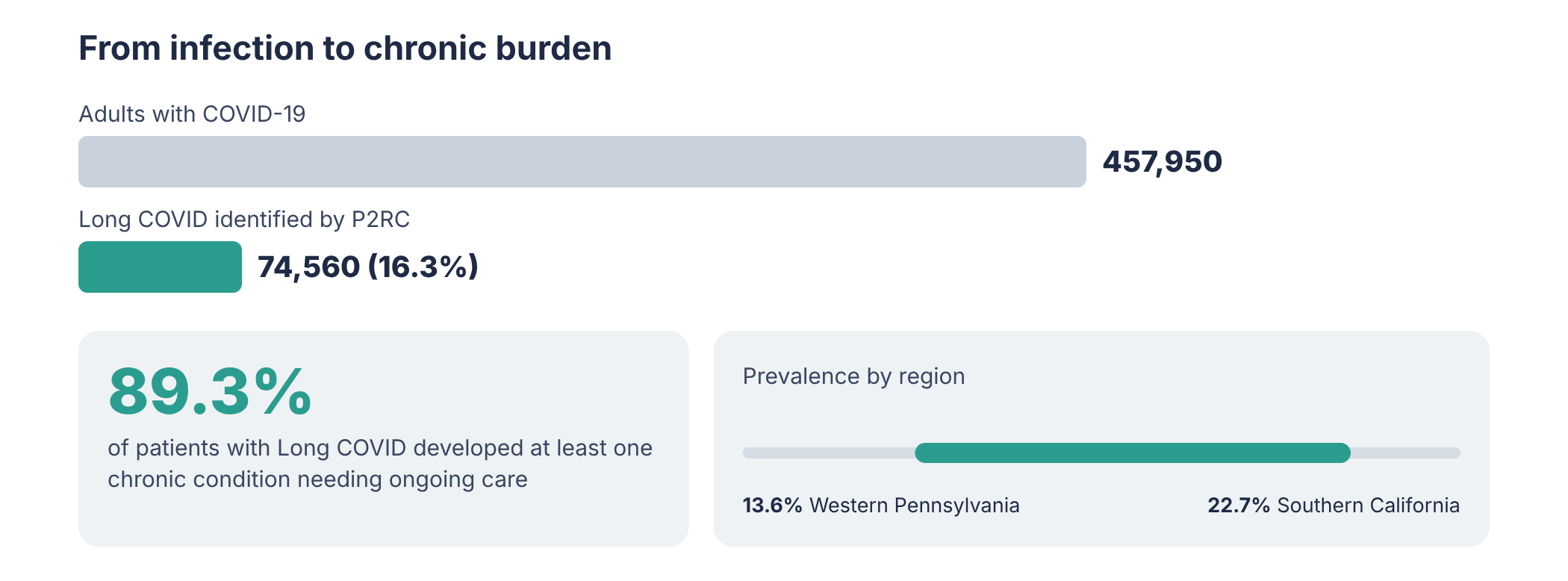
P2RC identified Long COVID in 74,560 of 457,950 patients (16.3%). Prevalence ranged from 13.6% in Western Pennsylvania to 22.7% in Southern California. Among patients with Long COVID, 89.3% developed at least one chronic condition that required ongoing clinical management, so the burden accumulates in the health system long after the acute infection resolves. Systemic, respiratory, and gastrointestinal symptoms were common in all four regions, whereas thyroid conditions were more frequent in New England and metabolic abnormalities such as prediabetes and hyperglycemia were more frequent in the other three regions.
Prevalence rose in all four regions through mid-2024. If the quarterly increases we observed, between 0.3% and 1.5%, were to continue, cumulative prevalence would grow by 13% to 81% over a decade.
Consequences beyond surveillance
Surveillance counts shape research funding, clinic staffing, and, for many patients, whether a condition is recognized at all. “Over 10 million people with long COVID would go entirely undetected by the diagnostic code,” said Hossein Estiri, the study’s senior author.
As Bloomberg Law reported, insurers, disability courts, and specialty Long COVID clinics often require the diagnosis on paper before they act. Patients whose records describe the condition without naming it can lose coverage and access to care. “The objective markers exist,” Estiri told Bloomberg Law. “They’re just sitting in the wrong layer of the medical record.”
Phenotyping algorithms that read the full longitudinal record can close this gap at scale. Because P2RC runs within each health system, it can update estimates as new infections and new sequelae accumulate, and patient data stay where they were collected. The same principle underlies our work on diagnostic signal decay and temporal phenotyping, where we read clinical meaning from the pattern of a record over time.
Read the paper
Tian J, Azhir A, Decaro M, Chau N, Hügel J, Morris M, Cheng J, Fard P, Bassett IV, Bell DS, Bernstam EV, Visweswaran S, Klann JG, Murphy SN, Estiri H. Long COVID Persistence and Surveillance Gaps Across 58 US Hospitals. JAMA Network Open. 2026. doi:10.1001/jamanetworkopen.2026.14909
See the press coverage of this study.