A National Neural Network for Health Care
Coordinating federal broadband funding with clinical AI could extend care to the regions with the fewest physicians
Created Jan 26, 2026 - Last updated: Oct 30, 2026
Section 5 of the December 2025 executive order on artificial intelligence ties state eligibility for federal broadband funding to alignment with national AI policy. In an opinion piece for the Milbank Quarterly, Pedram Fard and Hossein Estiri argue that this provision concerns infrastructure more than regulation. Because clinical AI depends on reliable broadband, coordinated investment in both could support a national deployment of clinical AI in the regions that have the fewest physicians.
The shortage the network would address
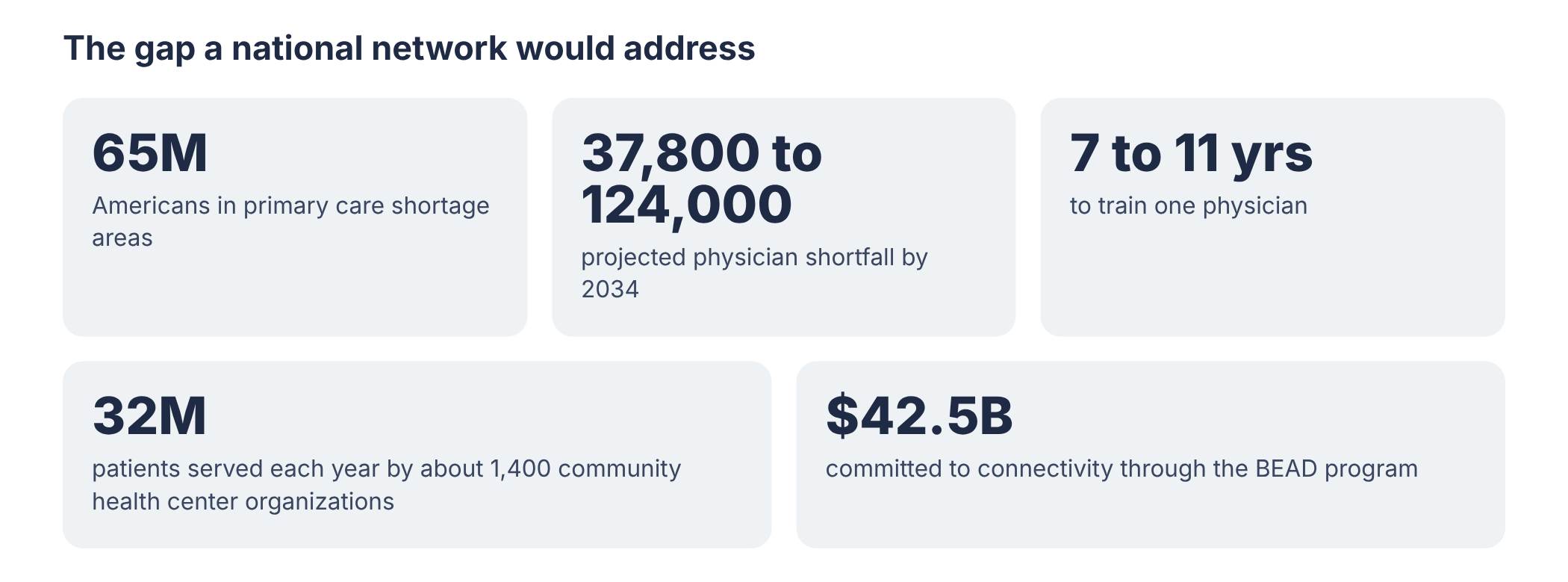
The Association of American Medical Colleges projects a shortfall of 37,800 to 124,000 physicians by 2034. About 65 million Americans live in primary care shortage areas with fewer than one physician per 3,500 residents, and minimally adequate coverage would require about 14,500 additional primary care physicians. Training one physician takes 7 to 11 years. Community health centers already serve 32 million patients a year through about 1,400 organizations and more than 16,000 sites, which makes them the natural point of entry for AI-supported care. The Broadband Equity, Access, and Deployment (BEAD) program commits $42.5 billion to the connectivity that such care requires.
A Federal-Rural AI Corridor
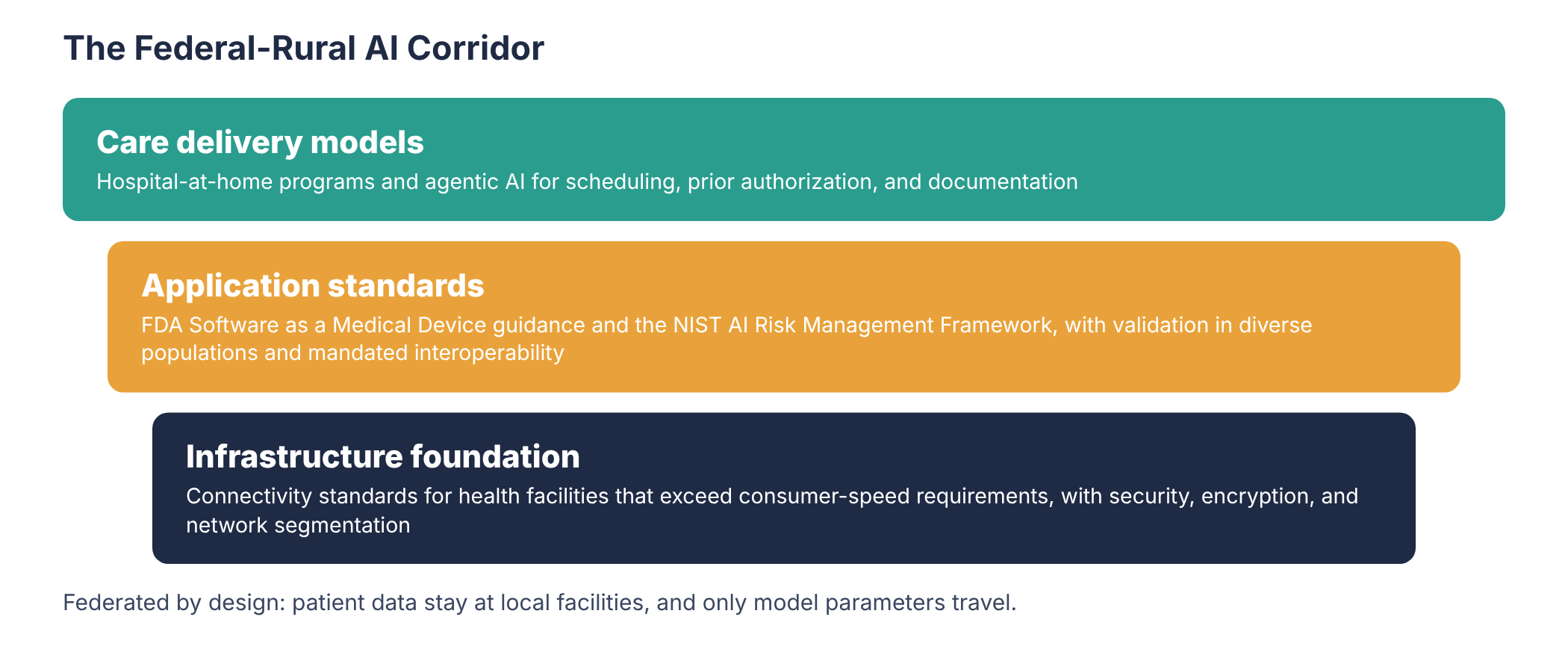
The authors propose a Federal-Rural AI Corridor built in three layers. At the foundation, connectivity standards for health facilities would exceed the consumer-speed requirements in BEAD and add stronger security, encryption, and network segmentation. Application standards form the second layer, drawing on Food and Drug Administration guidance for Software as a Medical Device and the National Institute of Standards and Technology AI Risk Management Framework, with emphasis on validation in diverse populations, mandated interoperability, and limits on extrapolation. Care delivery models complete the corridor and would begin with low-risk, high-value uses such as hospital-at-home programs and agentic AI for scheduling, prior authorization, and documentation, where agentic tools could reclaim up to 40% of the physician time those tasks consume.
Federated by design
The piece calls for a federated architecture in which patient data stay at local facilities and only model parameters travel between sites. The authors present this design as a safeguard against “data colonialism.” The same architecture underlies our NVIDIA-supported work on cross-institutional agentic clinical AI. The authors called for coordinated action during the policy design window of early 2026. Their list spans the National Telecommunications and Information Administration, the Food and Drug Administration, the Centers for Medicare & Medicaid Services, the Health Resources and Services Administration, and the Office of the National Coordinator for Health Information Technology.
Read the piece
Fard P, Estiri H. A National Neural Network: AI-Broadband Symbiosis as Health Infrastructure. Milbank Quarterly Opinion. January 26, 2026. milbank.org