The Opportunity Cost of Market Narratives in Health Care AI
A NAM Perspective on what health systems give up when AI spending outruns the evidence
Created Jun 8, 2026 - Last updated: Oct 30, 2026
In a commentary for NAM Perspectives, the discussion series of the National Academy of Medicine, Dr. Estiri argues that enthusiasm for AI in health care has outrun the evidence for it. Health systems, in his assessment, are unprepared for a market correction that has already begun. The question each institution must answer is whether its AI investments serve patient welfare or mainly generate public relations value.
Signals of a correction
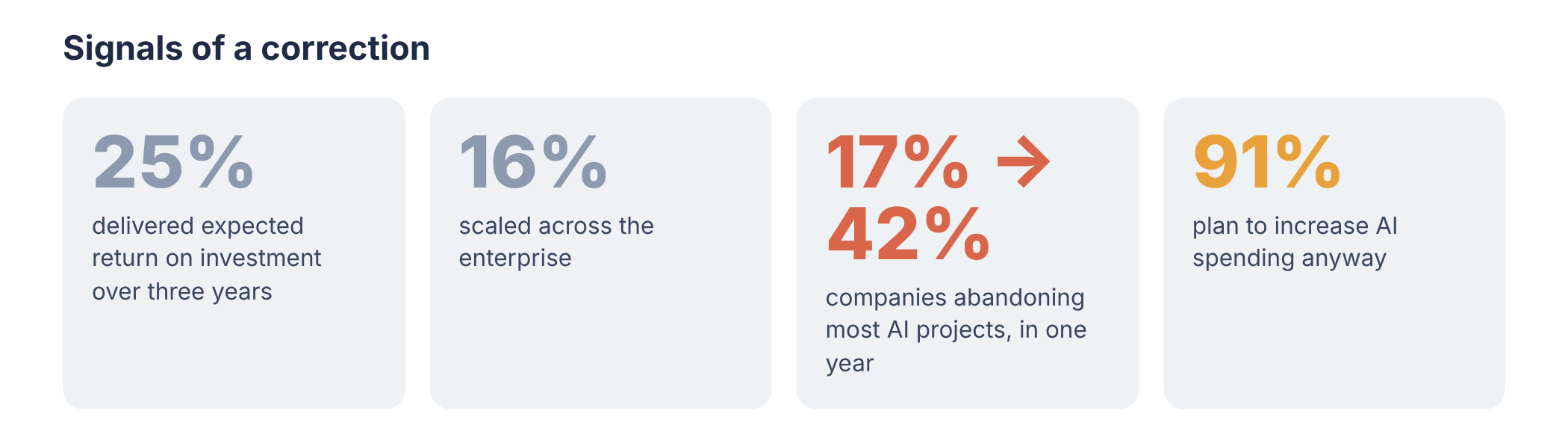
Enterprise AI now shows the financial pattern of a bubble. Only 25% of AI initiatives delivered their expected return on investment over three years, and 16% scaled across the enterprise. In one year, the share of companies abandoning most of their AI projects rose from 17% to 42%, yet 91% of organizations plan to increase AI spending. Digital health funding reached $3.5 billion in the third quarter of 2025, with megadeals accounting for 39% of it. Through that quarter, Series B deals fell to about 30, compared with more than 60 per year over the prior four years, which suggests that many AI companies have yet to demonstrate commercial viability.
Genuine gains with a narrow scope
Ambient documentation offers the clearest benefit so far. Studies covering more than 2.5 million uses report about 20 minutes saved per day and lower clinician burnout. The commentary accepts this gain and classifies it as clerical, since ambient tools automate documentation while the clinical mission stays largely unchanged. Patient expectations point elsewhere: 19% of patients expect AI to make care more affordable, and 20% expect it to improve their relationship with their physician.
The cost of misplaced attention
“Deployment is not validation, adoption is not evidence, and potential is not performance,” Dr. Estiri writes. The harm he identifies is opportunity cost, because money, clinician time, and institutional attention spent on AI that leaves outcomes unchanged become unavailable for interventions that improve them.
Seven questions for health systems
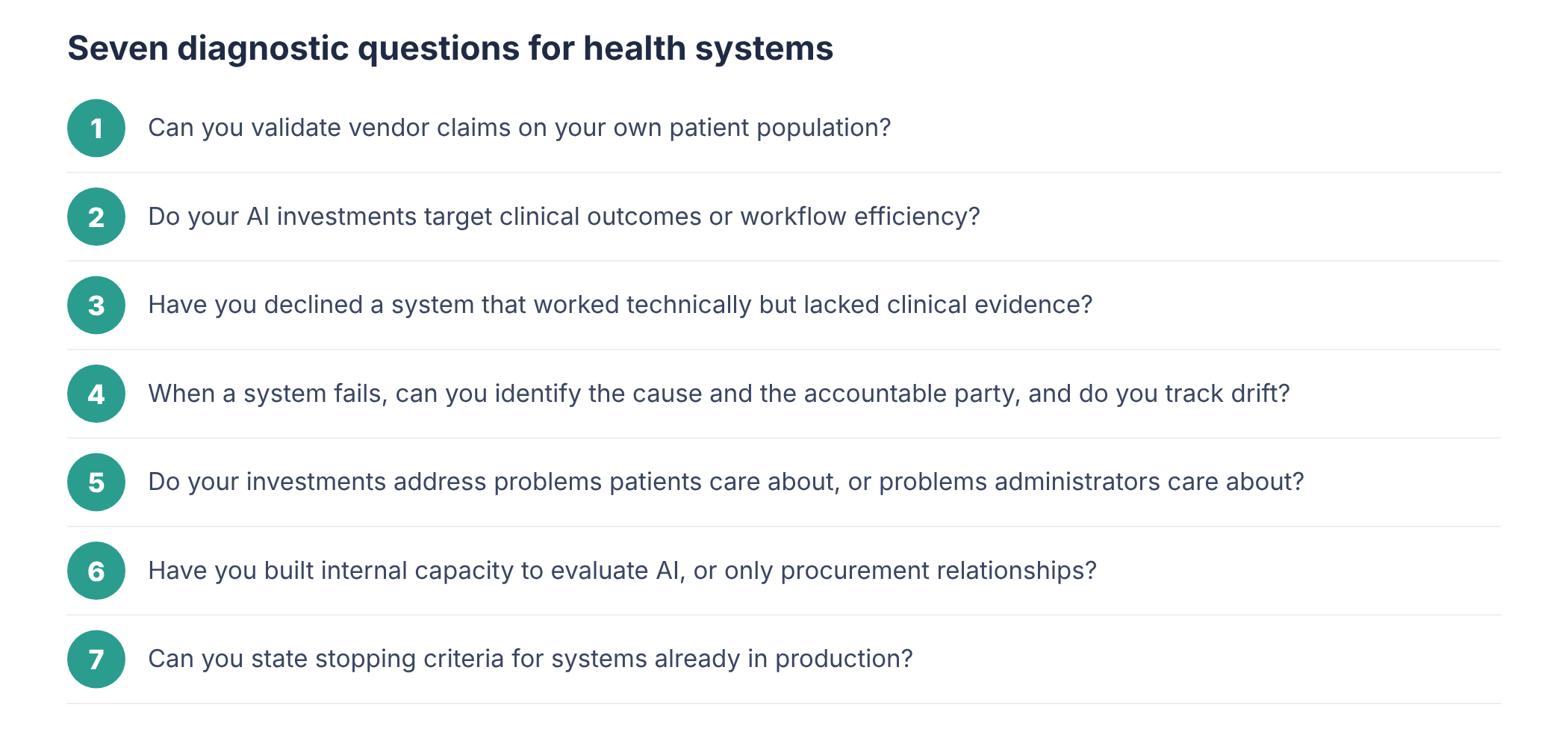
The commentary closes with seven diagnostic questions that an institution can apply to its own AI portfolio. The first three ask whether the institution can validate vendor claims on its own patients, whether its investments target clinical outcomes or workflow efficiency, and whether it has ever declined a system that worked technically but lacked clinical evidence. The remaining four address accountability and drift monitoring when systems fail, alignment with problems that patients care about, internal evaluation capacity, and stopping criteria for systems already in production. From these questions follows a prescription: independent validation and monitoring infrastructure, performance thresholds that trigger reassessment, stopping criteria defined before deployment, and internal evaluation expertise that reduces dependence on vendors.
Read the commentary
Estiri H. The Opportunity Cost of Market Narratives in Health Care AI. NAM Perspectives. Commentary, National Academy of Medicine, Washington, DC. 2026. doi:10.31478/202606a