The Right Trial, for the Right Patients
At the RECOVER-TLC workshop, we argued that health records and AI can test a treatment idea in weeks, before a trial enrolls its first patient
Created Nov 5, 2026 - Last updated: Nov 5, 2026
On November 5, 2026, Hossein Estiri spoke on a panel at the third annual RECOVER-TLC workshop in Bethesda, Maryland. RECOVER-TLC (Treating Long COVID) is the NIH program that selects and tests candidate treatments for Long COVID. The talk made one argument: data and AI can now answer a key question before any trial begins. That question is whether a proposed trial is the right one to start, for the right patients, testing the right hypothesis. This post summarizes the talk and the evidence behind it.
Why Long COVID strains our standard tools
Long COVID may be the first illness in modern medicine for which few of our standard tools fit well. Those tools include the randomized trial pipeline, the p-values used to decide which effects are real, the usual pathways for generating hypotheses, and the health systems that deliver care. Each of these tools still works, but each was built for illnesses with a clear definition and a slower clock than Long COVID, whose patients need answers within months.
A new drug takes 10 to 15 years to develop, and most drugs tested in people fail. Repurposing an approved drug is faster because its safety profile is already known, and most Long COVID trials therefore test existing drugs. Even repurposing requires three things: a way to identify who has the illness, a way to tell its subtypes apart, and a way to measure recovery. At the start of the pandemic, Long COVID offered none of the three.
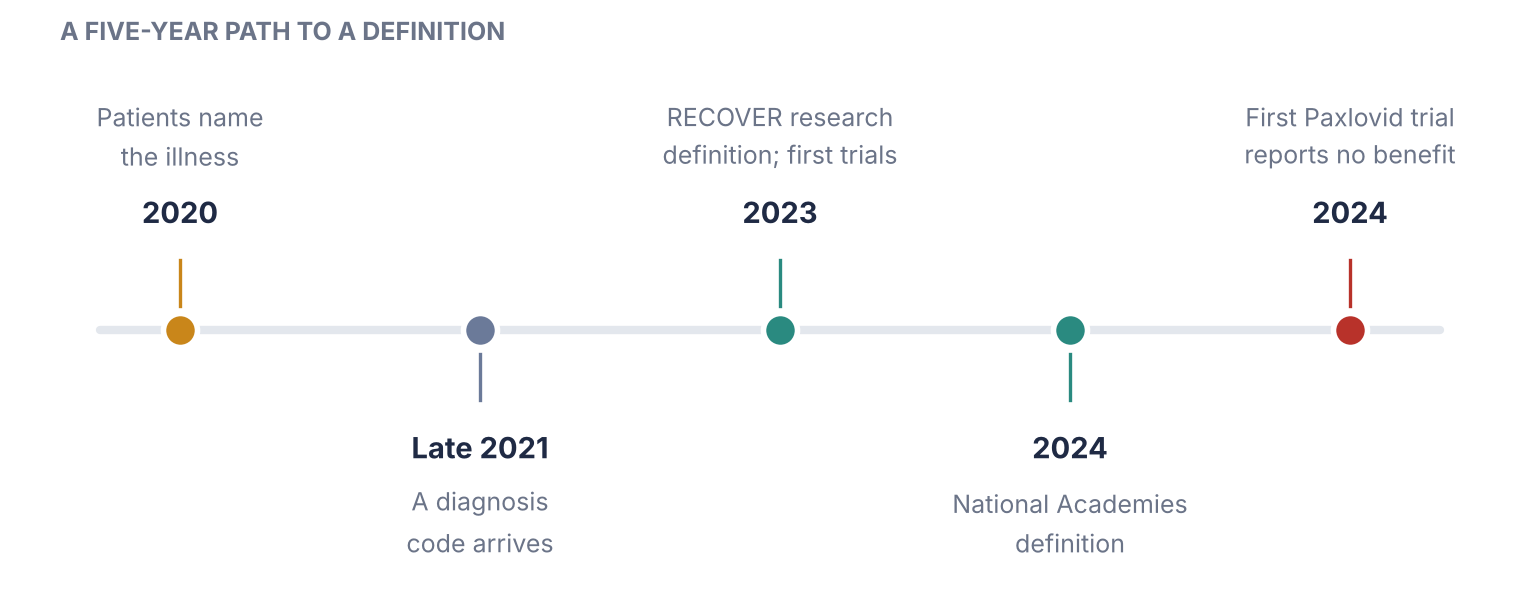
Patients named the illness themselves in 2020, and a diagnosis code followed in late 2021. RECOVER published a research definition and opened its first trials in 2023, and the National Academies published their definition in 2024. In that year, the first trial of Paxlovid (nirmatrelvir with ritonavir) reported no benefit.
Precision cohorts in health records
Our group spent two to three years teaching AI to find Long COVID in electronic health records. The result is what we call precision PASC research cohorts, or P2RCs. The algorithm counts a health problem as Long COVID only when the problem begins after infection, persists, and has no earlier explanation in the patient’s record. When clinicians reviewed charts by hand, they confirmed the algorithm’s label in about 8 of 10 patients. Across 58 hospitals, the current P2RCs include 74,560 people. These cohorts helped an NIH study of smell loss find participants, and our data show they can make recruitment at least three times faster. We offered the multisite cohort to RECOVER to help find patients for the next RECOVER-TLC trials.
With a cohort ready, a treatment idea can be tested in records within weeks. The fair objection is confounding, because many factors change at once in Long COVID and one explanation can hide behind another. Clinicians tend to give new treatments to patients at higher risk, so a simple comparison of treated and untreated patients can make an effective drug look useless. Active comparator designs address this bias by comparing patients who received the drug of interest with patients who received a different treatment for the same indication.
Effects hidden in the average
Two trials gave Paxlovid to people who already had Long COVID. STOP-PASC enrolled 155 people and RECOVER-VITAL enrolled 964 people grouped by their main symptoms, and neither trial found a benefit.
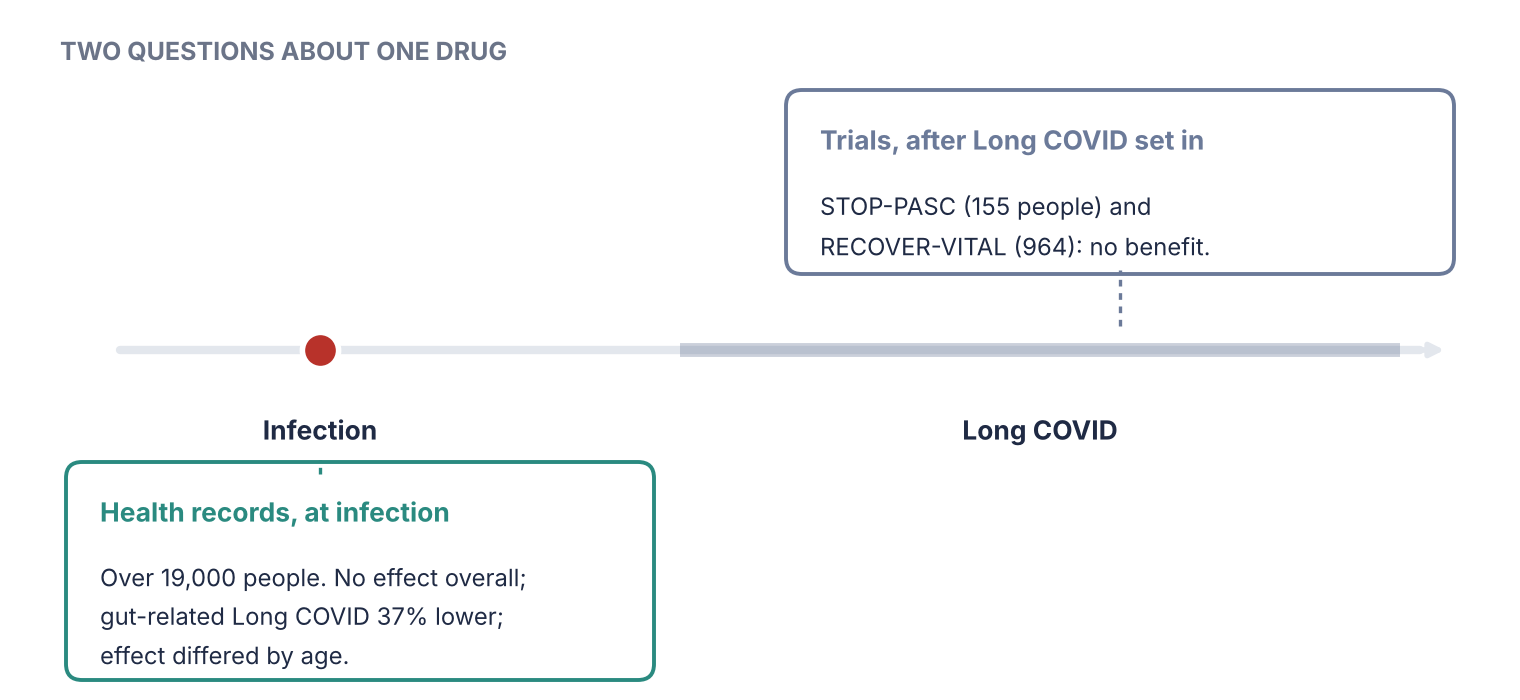
We asked a different question: what happens when Paxlovid is given at the time of infection? In more than 19,000 people, we found no overall effect. Gastrointestinal Long COVID, however, was 37% lower among treated patients, and the effect differed by age. These results were in hand by July 2024, while RECOVER-VITAL was still enrolling. They do not show that Paxlovid treats Long COVID. They show what large records can hand to a trial before enrollment: the subgroup to target, the outcome to measure, a plausible effect size, and an estimate of feasibility.
Questions records can answer next
Combining a precision cohort with a measure of recovery yields questions that can be checked before a trial is designed. We do not claim that metformin speeds recovery from Long COVID. A precision cohort can test within weeks whether people with diabetes who take metformin recover faster than those taking other diabetes drugs, and the answer can shape which subgroup and which outcome a trial should target.
From a good idea to the first patient
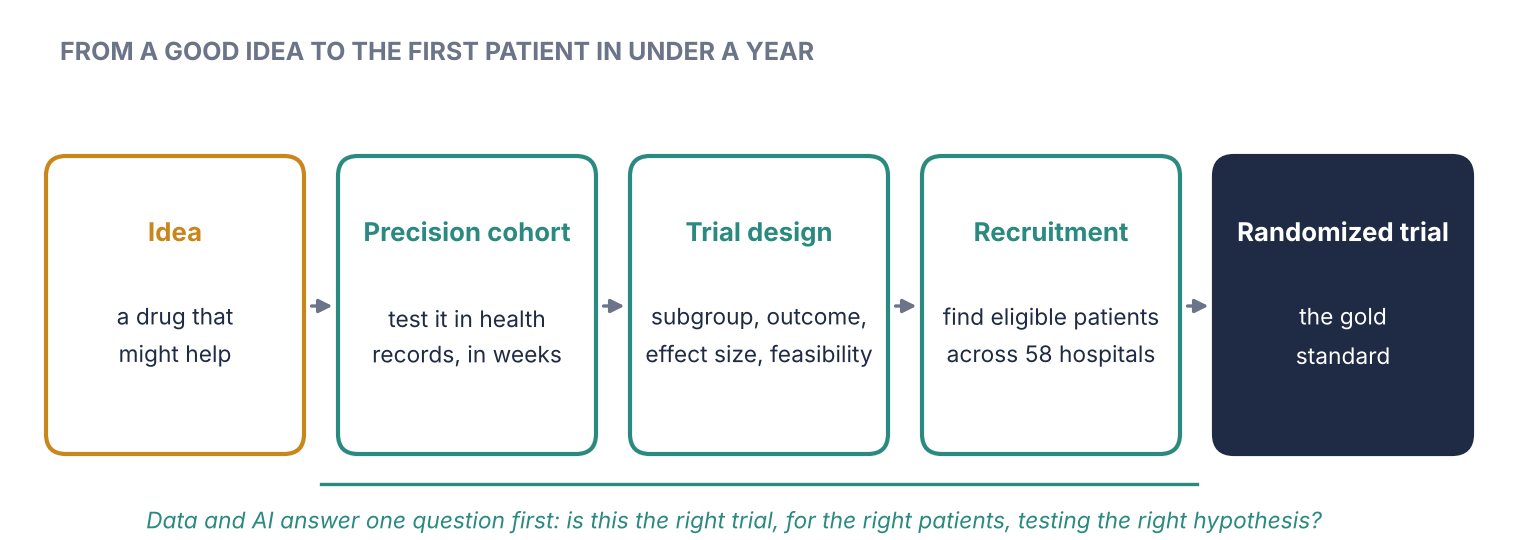
The goal we proposed is to move from a promising idea to the first enrolled patient in under a year, with the randomized trial remaining the gold standard. Health records and AI do the work upstream of the trial: they test the idea, choose the subgroup and the outcome, size the expected effect, and find eligible patients. Making this routine requires many partners. NIH supports it through RECOVER and through smaller parallel projects such as ours, and the work also needs other agencies, including ARPA-H, along with health systems, industry, and patients.
Related work: Absent From the Code, our 58-hospital study of how diagnostic codes undercount Long COVID.